Spring — Year 4
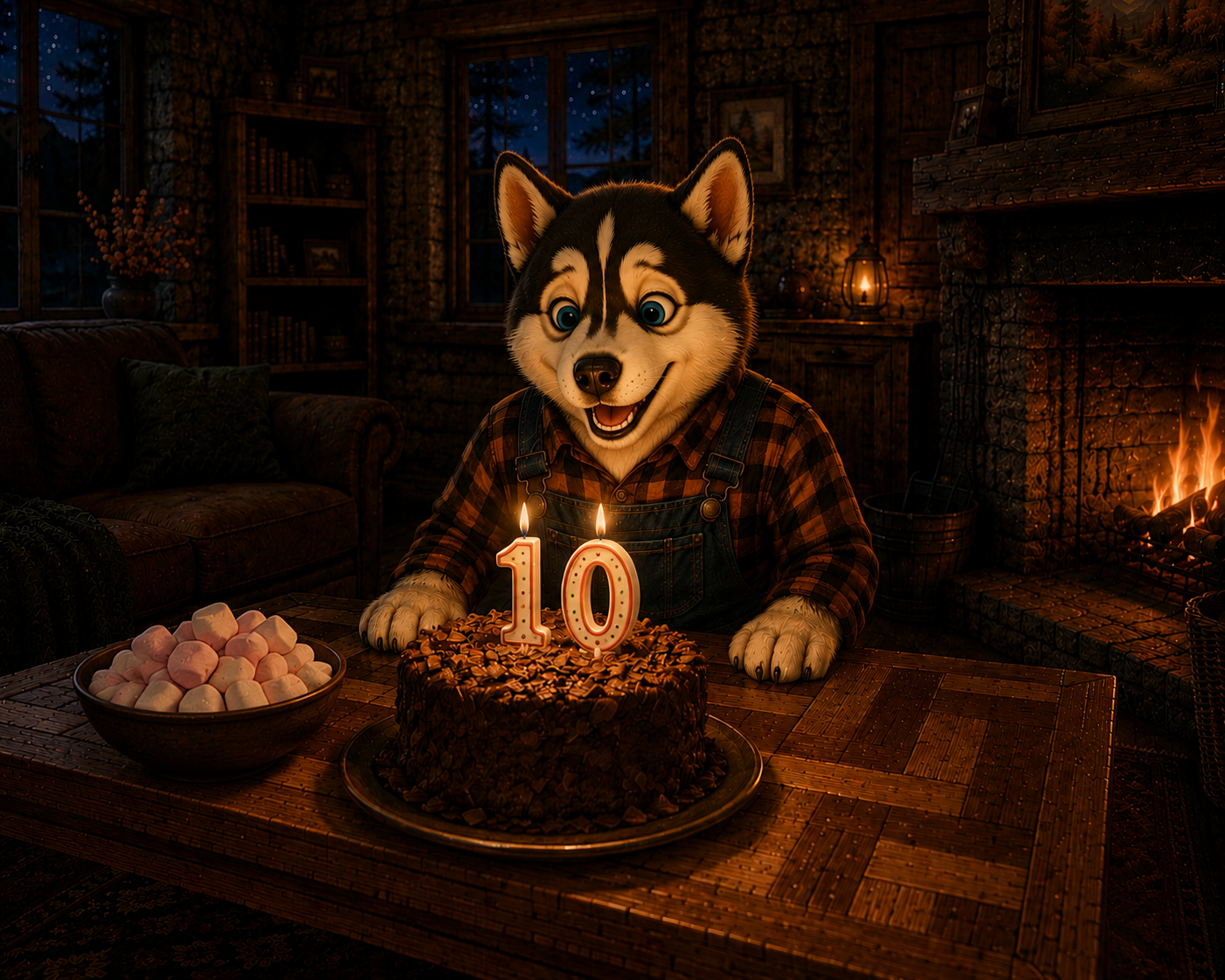
Angus was about to turn ten, a significant milestone, moving from single to double digits. The cake, as usual was baked by Charlie, chocolate, moist, with rich dark chocolate icing — right down the sides, and covered in chocolate shavings. On top, two candles: a number one, and a zero, befitting a birthday of special magnificence. The twin flames of light signifying him becoming another year older. In addition, a huge bowl of pink and white marshmallows, and along with chocolate, one of Angus’ firm favourites. Angus, for once, was firmly the well-deserved centre of attention in a full house warm with celebration.
Just before eight o’clock, Grandpa Jake slipped into his den expecting his familiar call from his friend Marvin Huxley. It was not long before he returned to the party and came over to Lewis with a look of cryptic intrigue.

Grandpa Jake: Lewis, I’ve just had a call from General Huxley.
He’d like you to go out and take a look at Betelgeuse — tonight.
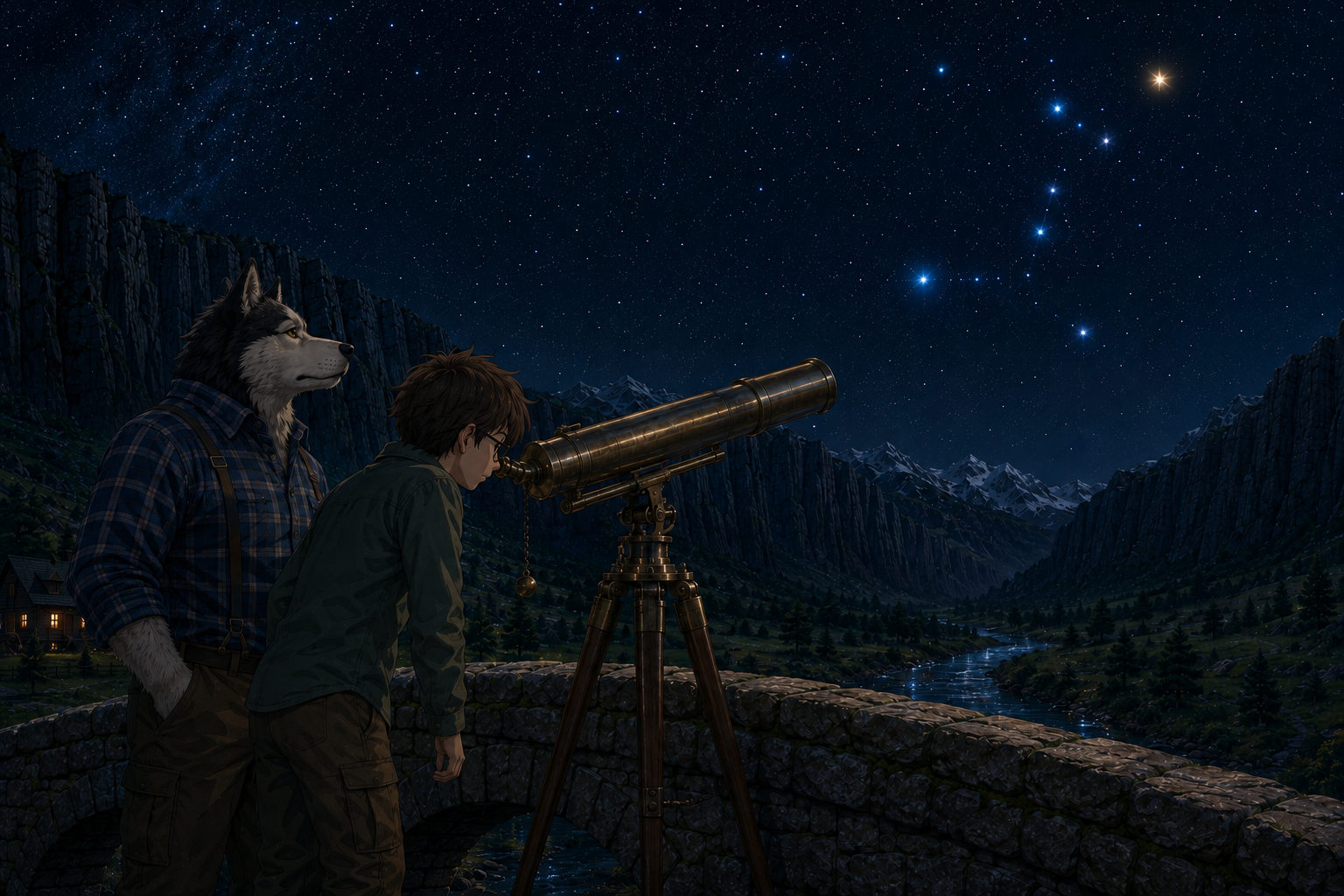
Lewis did not need to be told twice. Grabbing his tablet, he headed straight to the cupboard under the stairs where the old brass telescope was kept. Together Lewis and Grandpa Jake went outside to their favourite viewing spot, the stone bridge.
Before long Lewis had the telescope set up and was seeking out Betelgeuse. Orion had just risen above the horizon. Looking through the eyepiece of the finderscope he carefully adjusted the focus expecting to resolve the bright circular disc of the ancient star.

Lewis: Oh. Wow. That’s…
Lewis stepped back from the telescope, and looked up at the inky blackness of the night sky studded with countless stars, but also to double check he was looking in the right place. There it was, just as usual, part of the Orion constellation, but tonight something was different, very different. Not the cyclic brightening and dimming that he had been tracking and making careful data recordings of over the last three years, but something truly mind boggling.
Lewis: Grandpa! You gotta see this!
Jake looked through the eyepiece for himself. By now, after three years of looking at Betelgeuse with Lewis he had become quite familiar with it. However, this time it looked significantly different. A long visible distortion protruded out from one side distorting its usual spherical shape, and the side with the protrusion was noticeably brighter than the other.
A thought flashed through Grandpa Jake’s mind, a visible protrusion that big would have had to reach millions of kilometres out into space. What would a flare like that mean for the hyperspace corridor that ran right by in its virtual neighbourhood, just five light years away at its closest point, and the only current known link between Earth and Hundeerde? Earth, the current location of Duncan and Clara.
Lewis and Grandpa Jake were looking at an enormous, historic mass ejection from out the side of the aging star, the old light of the phenomenon having taken around 500 years to reach Hundeerde. While this was old news, the implications were clear; if the star was capable of a solar flare that large 500 years ago, what could it be capable of now?
Lewis took another long look through the telescope. Finally he stood and spoke.
Lewis: Grandpa? I need to call General Huxley. Right now.
Grandpa Jake: Yes, Lewis. I agree.
I suspect he is waiting for your call.
Grandpa Jake took his phone from his pocket and dialled. It was answered on the first ring.

Huxley: Jake! Put me on speaker to Lewis.
Grandpa Jake tapped speaker and handed the phone to Lewis.
Lewis: Good evening, Sir. It’s Lewis here.
Huxley: Report. What do you see?
Lewis: I see a massive coronal protrusion distorting the visible disc.
I estimate it would extend into space out from the western hemisphere at least three times the diameter of the star, Sir.
Huxley: Analysis?
Lewis: This is 500 year old data, Sir, but this solar flare was a massive event. It would have disrupted the local neighbourhood significantly with highly ionised particulate solar winds. Anything within at least ten light years would have been a no-go zone, if there had been interstellar space travel back then.
Huxley: I concur. We are reading the same telemetry.
Your recommendation?
Lewis: I need current data, Sir. I need to know what Betelgeuse is doing right now in real time. I can then run a comparative analysis of my last three years of historic data alongside current data, to make a definitive assessment.
Huxley: I agree. I’ll authorise you real-time access to all current telemetry monitoring data of Betelgeuse — plus access to all its historic data. That’s around 100 years worth.
How long do you need?
Lewis didn’t hesitate with his answer.
Lewis: One week, Sir.
And, Sir?
If this is what it was capable of… five hundred years ago. It can do it again. That’s what I need to analyse and model.
Huxley: Understood. Proceed.
After the call Lewis looked at Grandpa Jake with a — did that just actually happen? — look.
Grandpa Jake: The General has great confidence in you, Lewis.
Now… I wonder if there is any cake left…?
Lewis and Grandpa Jake took one last look at Betelgeuse before packing up the telescope and heading back inside. Lewis paused to make a note on his tablet… tonight’s entry one of — special magnificence.
One week later…
Lewis: I compared three sets of data, Sir.
First, the 500 year old historic data:
- Betelgeuse was capable of a coronal mass ejection, distorting the sphere, extending a significant distance into space, of at least three stellar diameters
- This would have caused massive solar winds and disruption within tens of light years
- The historic event currently visible would have caused a no-go zone of at least fifty light years — refined estimate — had interstellar travel been in existence back then
- This provides proof of maximum historic capability
- This instability has been ongoing in regular cycles for hundreds of years
Second, the baseline recorded data of the last 100 years:
- Increased cyclic periods of dimming and brightening in both apparent and absolute magnitude
- Inconsistent luminosity throughout the sphere, with darkened areas
- Regular solar storms causing ionic disturbance within its solar system and beyond
- Since the beginning of hyperspace solar current travel, the Delta-6-Gamma-9 corridor has been closed three times. Once fifty three years ago, and two more recent within the last 10 years.
Thirdly, what is happening right now from current real-time telemetry:
- Generalised instability of the coronal surface resulting in an increased trend of solar storms, sitting well above historic baselines
- Intermittent minor disturbances from variable solar winds in the Delta-6-Gamma-9 corridor at the point of closest approach — five light years.
- Potential for significant disruption resulting in the partial or total collapse of Delta-6-Gamma-9
- Modelling does not predict timing but can predict scale potentiality.
Huxley: Recommendation?
Lewis: Continued close monitoring, with contingency awareness for corridor transit.
Huxley: Confidence?
Lewis: High, Sir.
Huxley: Funny feeling?
There was a slight pause, as Lewis searched the place in his gut where his funny feelings came from.
Lewis: The dragon is sleeping, snoring loudly and making the occasional fart under the covers.
Huxley: Noted.
After the call ended, Huxley sat back in his chair and steepled his fingers in contemplative thought. He murmured quietly to himself.
Huxley: I like that boy.


One thought on “Episode 50: Old Light”