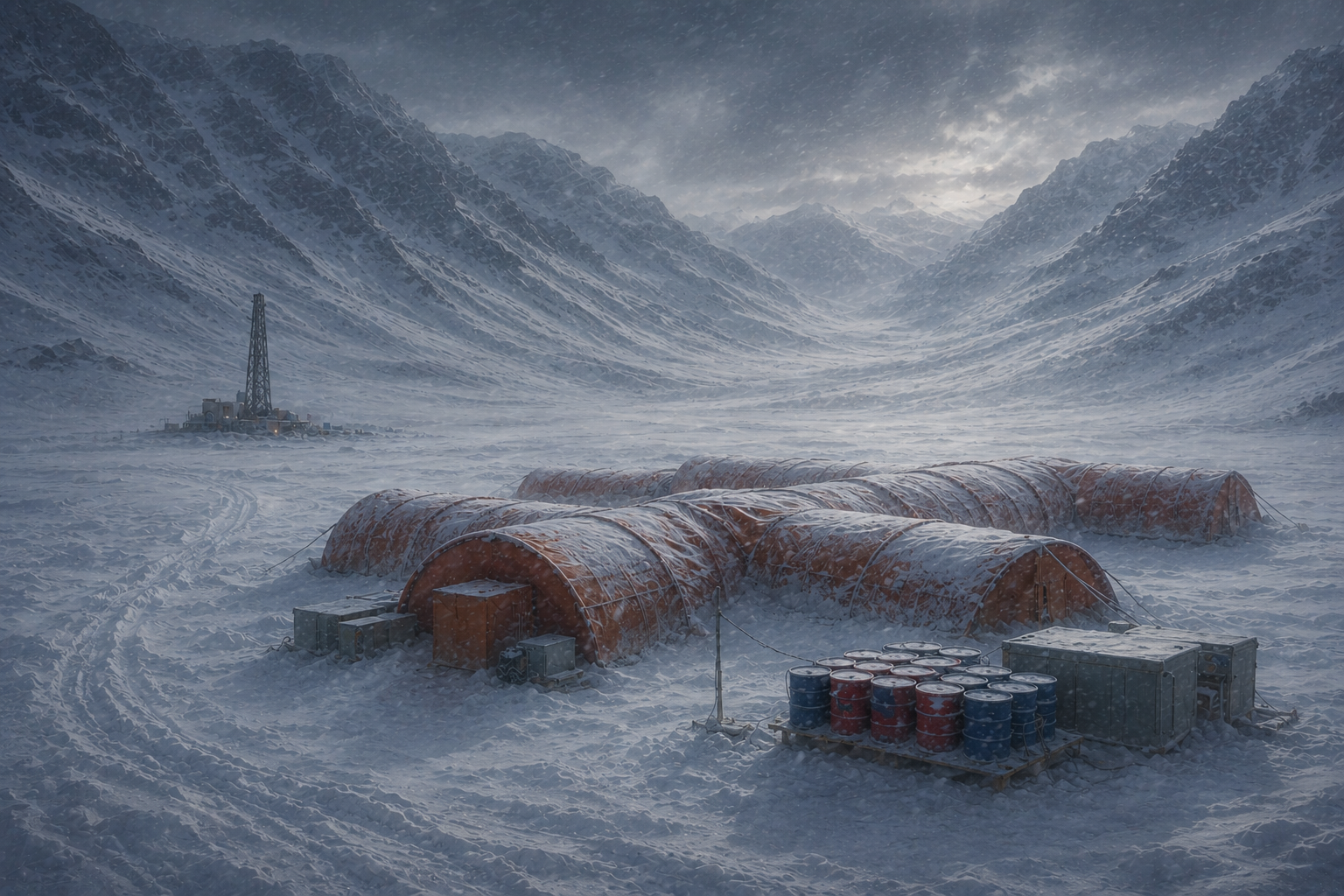
Thermal Array – 3: Research Drilling Station, High Arctic
❄️ The Storm: Day Two
The storm did not pass; instead, it strengthened.
Through the second day, severe katabatic winds drove down from the heights, pummelling every surface, every line, and every anchor point.
The tents flexed continuously under the sustained force, snapping back and forth against their anchors as fabric and seams strained to their limits.
Small tears had begun to appear in the outer shells, while snow drifted and built up along the sides and across the roofs, adding further weight and stress.
A sharp, whip-like crack sounded from just outside the main tent.

Matthias: An anchor point’s given way. I’m going out.
Rebecca pulled herself up to her full five feet.

Rebecca: Negative. You wait for a lull.
Matthias was in no mood to ignore a known infrastructural weak point. He shook his head and moved towards the door.
Matthias: There’ll be no lull. I’m going out.
A tense and brief pause ensued and then came an intervention before tempers frayed any further.

Huxley: Harness and tether line. Take Markus. You have two minutes.
The door opened just long enough to let Matthias and Markus push out into the storm, clipped onto a guide rope that vanished almost immediately into the whiteout.
The tent shuddered again violently.
Rebecca stood watching the door a few moments longer after it sealed shut, her arms folded tightly across her chest.
Inside and out, all the camp systems, human, hunde, and plant, were having to work harder to keep up.
The sound from the generator had again changed.
It wasn’t a dramatic change, but one that was just enough to be noticed.
Matthias heard it begin to labour the moment he came back in. He was so covered in snow that he could have been mistaken for the abominable snow-hunde.
Matthias: That’s not right.
Markus, just as covered in snow as Matthias, moved past him, already listening, his ears forward.

Markus: She’s labouring a lot more than before.
At that moment, the lights flickered once, then as before, they steadied.
Huxley looked across from where he stood, a concerned frown etched into his brow.
Huxley: Report.
Matthias crouched near the floor, listening intently to the engine through the door.
Matthias: It’s the fuel. The diesel’s starting to wax. It’ll be clogging the fuel filter.
Markus: I agree.
Matthias: We go back out? It’ll take five minutes to change.
Markus didn’t answer immediately.
Markus: We go back out, but we’ll need to shut the generator down briefly—
and we’ll need her to start up again.
Matthias had a considered look on his face.
Matthias: We can thin the diesel with kerosene.
Markus: Maybe. That’s a bit of an old school remedy, let’s keep that as a last resort.
Matthias: Let’s get her filter changed, then.
Markus looked to Huxley for confirmation.
Huxley looked tired and grim. The camp needed power, and the one system providing it was starting to struggle.
He gave a brief nod.
Huxley: Ten minutes.
The engineers changed the filter and the generator was restarted. However, it took them three tries as the cold starter battery battled to turn the engine over. After a few tense moments, both inside and out, the lights came back on.
Markus, however, was still worried. A filter change did not fix the thickening fuel.
On their return exactly eleven minutes later, the two engineers brought in yet another load of fresh snow. Rebecca was too busy attending to Lucas to notice.
Lucas sat quietly in the corner of the main tent, looking at nothing in particular. He had hardly spoken a word all morning.

Lucas: I’m not feeling too good, Bec. I think I’m burning up…
Rebecca crouched beside him, pressing the back of her paw lightly against his forehead.
Rebecca: Yep, you’re definitely running a fever.
Lucas gave a weak shrug.
Lucas: Lousy timing for getting a sniffle.
Lucas rubbed at his nose with the back of his hand, sniffing loudly.
Rebecca handed him a drink, two paracetamol, and a box of tissues.
Rebecca: You need to keep drinking. Your body needs plenty of fluids to help flush out the bugs.
Lucas nodded, accepting the drink and pills without any protest. He immediately started working his way through the tissue box.
Rebecca was just about to shoo Lucas off to bed when Elena approached with her thermal probe.
Lucas gave a wild-eyed look in Rebecca’s direction.
Lucas: Don’t let her near me with that thing!
She’s not that kind of doctor!
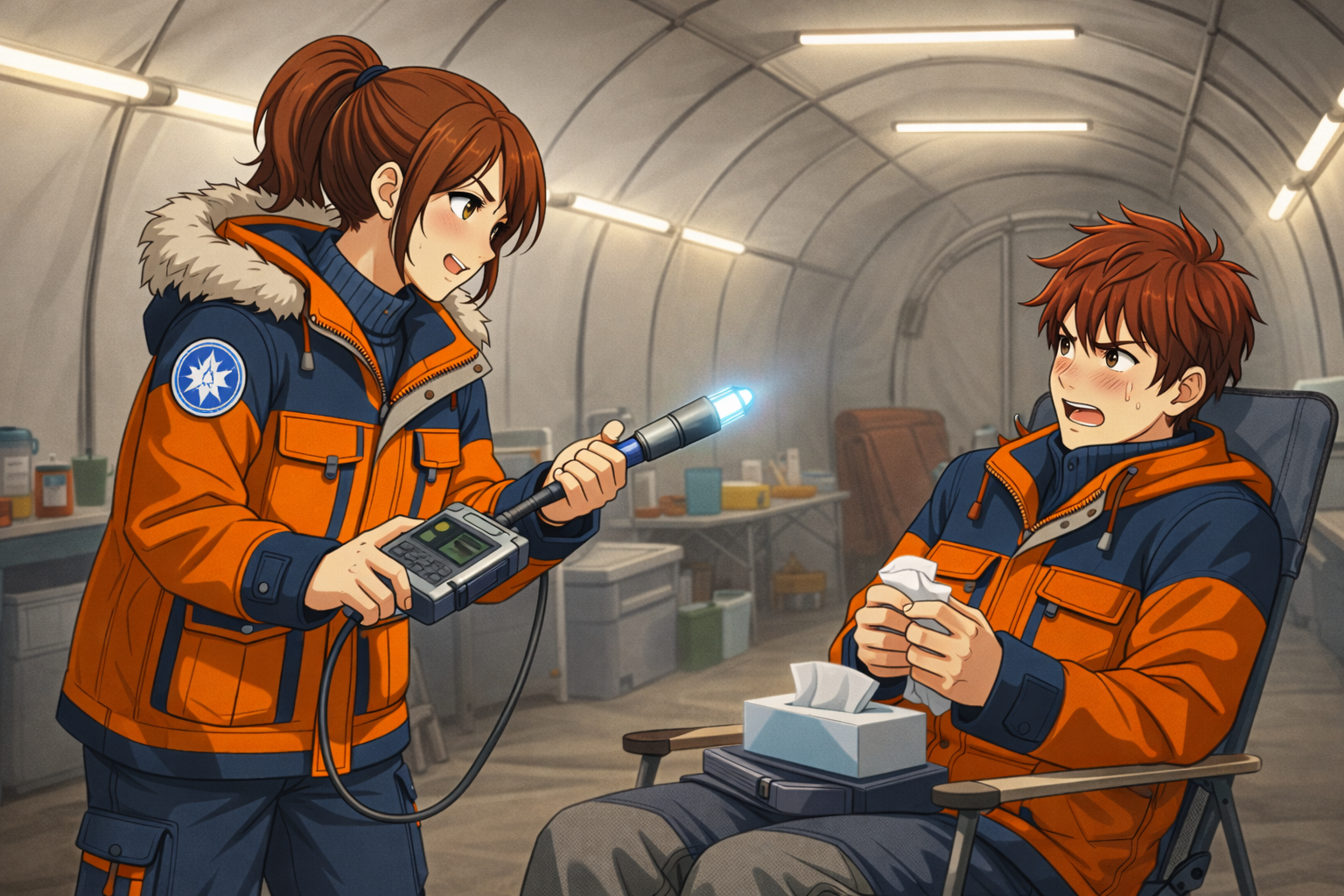
Rebecca: You are not experimenting on him with that.

Elena: I am not experimenting. I am collecting data.
The tip of the probe gave off a faint, steady glow as Lucas instinctively recoiled, shivered, and leaned back in his chair.
Lucas: Nope.
I’m not dying just yet.
James had finally come out of the laboratory and joined the main group. He walked over to the main workstation and sought out the two engineers who were still monitoring the generator.

James: Hey lads, what’s up with the power? The lights have been a bit spotty in the lab. Is there anything I need to know about?
Markus: The cold’s been affecting the fuel. We’ve changed the filter, so hopefully the fluctuations will settle.
James: That’s good. There’s a lot of sensitive equipment in there that depends on the power staying on.
Markus: We’ll do our best, Jim.
Matthias: How are the borehole readings, Elena?
Elena had been keeping a closer eye on those very readings for the past hour.
Elena: I’ve been seeing some fluctuations. Nothing serious, but we’re not holding steady. Some readings are nearing the upper limits for temperature and pressure. Don’t worry, I’m on it.
The storm did not ease, but it no longer felt like it was trying to tear the camp apart. It simply kept on at the same intensity, pressing steadily.
Inside, the pace had slowed. There was little left to do or say that hadn’t already been done or said.
People drifted in ones or twos toward their bunks or found a place to sit, each settling into their own space as best they could.
Lucas was already tucked up in bed, seen to by Rebecca. He hadn’t argued.
Huxley remained on his feet a little longer than most, quietly scanning everything—just one more time. Saying little, missing nothing.
It was going to be a long night. No one expected to get much sleep.
Morning would come soon enough.
❄️ The Storm: Day Three
The storm had eased. Not by much, but just enough that visibility had now stretched beyond a few metres. The whiteout was no longer absolute. The wind still drove hard down the valley, but the camp, or at least the parts not covered by snow drift, could be seen again.
Inside, the tents were still warm and despite the overnight worries, the occasional engineering interventions, and the generator still battling with the fuel, it had just been able to hold on.
No one looked well rested. The crew were tired, but they too were still just hanging on.
Lucas sat on the side of the bed, shoulders hunched, his hands splinting his chest. The coughing had now arrived.
Rebecca passed him a drink of water.
Rebecca: How are you feeling?
Lucas gave a weak shrug.
Lucas: I’ve felt better.
In the comms centre, Eugene continued to work his station, coaxing any kind of readable signal out of the storm noise.
Huxley stood just behind him and he knew Eugene was doing his best.

Eugene: It’s still real patchy, Sir, the static wash is super noisy.
I can send and receive short bursts, but nothing’s clean.
Huxley: Were you able to get the latest Now-Sat?
Eugene: Yes, Sir. It’s eased a little. Not enough for aircraft, but marginally better than yesterday. We could be looking at a break, but nothing’s confirmed.
Huxley gave a short nod.
Huxley: Understood.

A dull, heavy thud reverberated throughout the tents, immediately followed by a tearing sound, fabric under load, giving way.
Rebecca looked up sharply.
Rebecca: That didn’t sound good.
Matthias was already moving. He was back a few minutes later. The news was not good.
Matthias: The supply annex has caved in completely. The snow load was too much for it.
Huxley: Shore it up as best you can.
Matthias and Markus disappeared again to do what they could. It wouldn’t be much.
The engineers were barely back from attending to the roof collapse when the generator surged yet again, coughing once and then twice.
The lights dimmed, brightened for a moment, and then failed completely.
Then, silence.
The silence was not complete, the wind still interrogated the walls, but the loss of the baseline generator throb was immediate.
Matthias looked at Markus with a look that only a fellow engineer would understand. The same look was returned.
Markus: Damnit. Again.
Jackets and gloves back on, they once more ventured out into the elements.
They tried the restart and the engine turned.
Once. Twice. Three times.
It did not and would not start.
Markus: Matt, better check her fuel filter.
Markus already knew what the answer would be. They had already changed it three times overnight.
Matthias: It’s completely clogged with wax again. You could make candles out of it.
And, they were now out of filters. Without the filters, the engine stood no chance with the thick, waxy fuel. They were out of options.
Inside, the emergency lighting kicked in, it was dim, functional, and finite.
Rebecca: Battery systems are online. Present status: fully charged. Estimate: 12 hours available.
Huxley gave a single nod.
Huxley: Prioritise essential systems only. We’re going to need to stretch that to 24 hours.
Emergency lighting and communications take priority.
Elena: Borehole pressures are still at the upper limits. Recommend continued monitoring.
Huxley: Minimal safe monitoring levels only. Pressure and temperature. One screen only.
Systems stepped down and all non-essential loads dropped away.
The change was immediate and noticed by all…
Including the scientist still diligently working away in the laboratory.
Brisk footsteps approached the main tent.
James: I’ve lost power again. My equipment is critically sensitive!
When will the power be back up?
Matthias: The generator is offline.
James: Then fix it!
Matthias: The fuel has waxed, and we are out of filters. We’re down to batteries.
James: Why wasn’t the fuel stabilised earlier?
At this point, Huxley stepped in to stop the argument developing any further.
Huxley: Gentlemen, we are not doing this.
In ten minutes, after everyone is done bouncing off the walls, we will still be right here, in the same situation. Let’s work the problem and figure out next steps calmly.
Matt and Mark have done their best.
You can have emergency power for the specimen storage unit. That’s it.
In the laboratory annex, the specimen unit stopped alarming, but James knew the batteries would only last for so long.
James returned to his laboratory and watched the temperature and humidity return to nominal limits.
Matthias muttered under his breath.
Matthias: It’s not just his equipment that’s critically sensitive…
Lucas shivered uncontrollably despite his high fever.
Rebecca sat beside him, cooling his forehead with a tepid towel.
Huxley appeared in the doorway. He exchanged glances with Rebecca, no discussion needed.
Huxley nodded once and left.
Huxley stood near the centre of the main tent, taking it all in.
- Generator offline
- Batteries on emergency power – a finite resource
- Critical structures compromised
- Lucas – seriously unwell and deteriorating
- Laboratory storage – compromised
- Borehole – temperature and pressure concerns
He had seen enough.
Huxley: We’re done here.
Multiple heads turned.
Huxley: Prepare for evacuation.
Eugene’s fingers were already moving across his keyboard.
Eugene: Sir, the signal’s marginal, but I’ll make it work.
Huxley: Do it.
The transmission went out in broken and repeated fragments.
Eugene muttered to himself:
Eugene: It’s like trying to hold a whispered conversation at a rock concert.
Word by word, he forced the message through a narrowing window of interference.
Adjusting, retrying, forcing a fragile thread of signal where there was barely any left.
- TA-3 Research facility…
- Requesting emergency evacuation…
- Eight personnel…
- One seriously unwell…
- Request medical assistance…
- Site compromised…
For a moment, nothing came back.
Then, a brief burst of static. A partial acknowledgement.
Then silence.
Eugene stared at his comms station, taking a moment to accept what he already knew.
Eugene: That’s it. That’s all we’re getting.
Elena remained at her station, her eyes fixed on the limited borehole data.
Elena: Temperature fluctuations are increasing. Pressure’s not stable.
Huxley: Define not stable.
Elena: Moving beyond…
Her eyes widened.
A new, low-frequency sound rolled across the ice. It was deep, heavy, and very different.
Elena looked up, with dawning comprehension.
Elena: That’s not the storm.
The sound came from the direction of the borehole.
A deep, primordial pressure release.
The ground shook. It was subtle at first, but then it was undeniable.
Then—
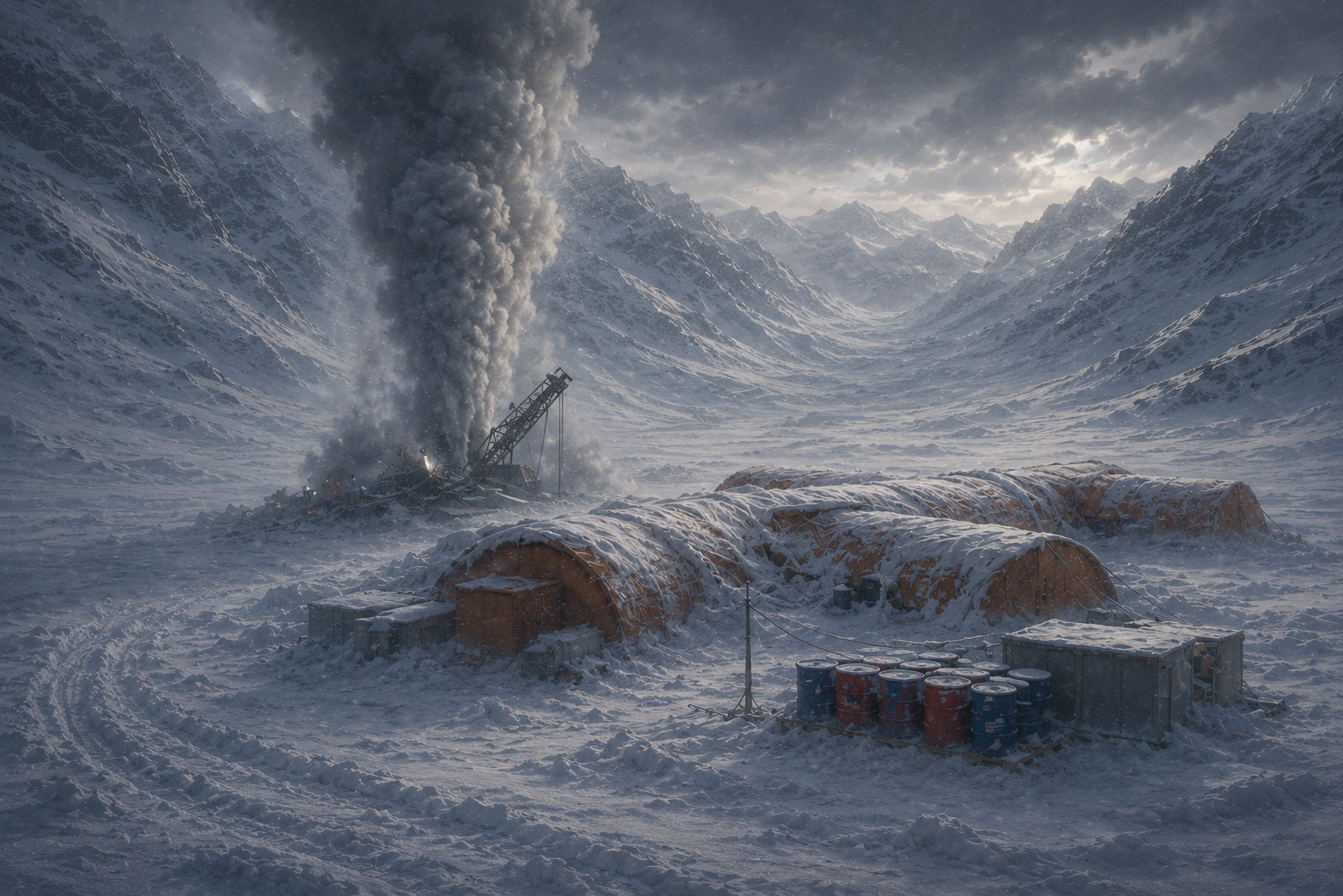
The borehole vented.
A geyser of water and steam punched high into the air, along with a sudden release of previously frozen organic material, dark fragments of fur, tissue, and bone.
A Pleistocene pressure cooker.
The wind shifted again and with the smell reaching them seconds later.
Thick, pungent, and most definitely organic.


If I was Lucas, I’d definitely keep my pants on.
She’s not that kind of doctor!
Lolz.